

What a total hip replacement is
The hip is a ball-and-socket joint. The head of the thigh bone moves inside the socket of the pelvis, and both surfaces are covered with cartilage. When the cartilage wears away, bone rubs on bone and every movement hurts.
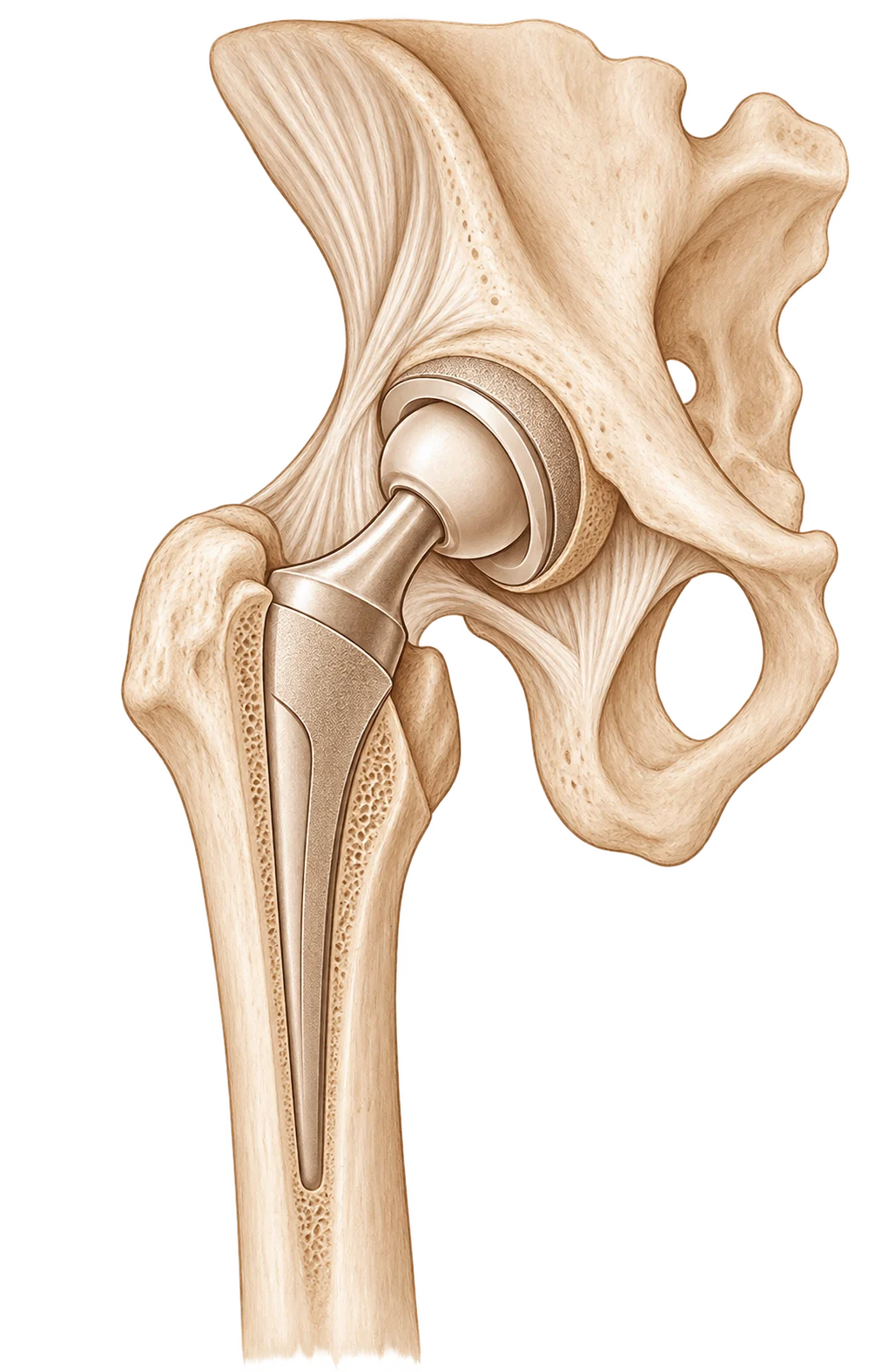
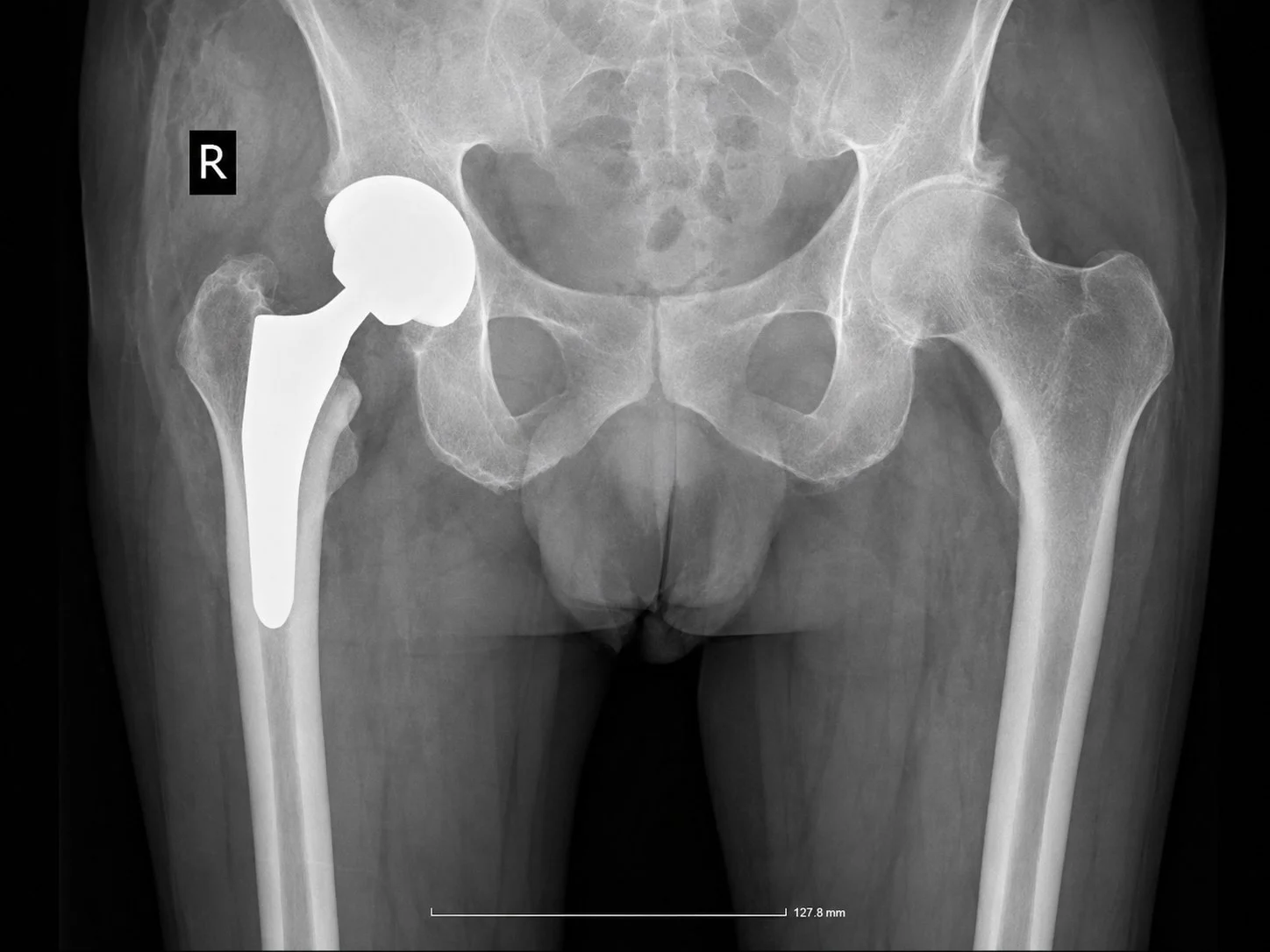
In a total hip replacement the surgeon removes the worn surfaces and fits an implant: a stem with a ball in the thigh bone and a cup in the socket. It is one of the most common and best studied operations in orthopaedics.
When it is needed
Surgery is discussed when pain limits everyday life and treatment without surgery is no longer enough. The most common causes are:
- Hip osteoarthritis, meaning cartilage wear over the years.
- Osteonecrosis of the femoral head, when the blood supply to the bone is disturbed.
- A fracture of the neck of the femur, mostly at an older age.
- Damage after femoroacetabular impingement (FAI) or dysplasia.
Typical signs are pain in the groin or buttock, trouble putting on socks and shoes, a limp and pain at night. Age alone is not the deciding factor. What counts is how much the hip limits you and what the examination and X-rays show.
What we try before surgery
A hip replacement is never the first step. In early and moderate hip osteoarthritis, many patients live well for years with treatment that does not involve an operation:
- Low-impact exercise such as swimming, cycling and walking on level ground.
- Physiotherapy to strengthen the gluteal muscles and keep the hip moving.
- Weight loss, where needed. Every kilo less reduces the load on the joint.
- Painkillers and anti-inflammatory medication for the hard spells, under medical guidance.
- A walking stick in the opposite hand, which rests the hip more than you would think.
In selected cases injection treatments are discussed too. When all of this is no longer enough, and pain sets your schedule, it is time to talk about surgery.
What the anterior ASI approach is
The approach is the route the surgeon takes to reach the joint. In ASI (Anterior Supine Intermuscular) the hip is reached from the front, through the natural gap between the muscles.
- The muscles are moved aside and not detached from the bone.
- You lie on your back, which helps the surgeon check leg length during the operation.
- The incision sits at the front of the thigh.
In a review of 21 studies published by Dr Skotidis in Cureus in 2023, looking at older patients with a femoral neck fracture, the anterior approach was linked to a lower dislocation rate than the posterior approach.
Is it right for everyone?
No. Anatomy, body weight, previous operations and bone quality all affect the choice. For some patients a different approach is safer. That is why the technique is chosen for each person, after a clinical and imaging assessment.
At your appointment you will see your own X-rays, hear your options and learn the benefits and risks of each one.
Anterior or posterior approach: what changes for you
Both approaches give very good long-term results in the hands of a surgeon who knows them well. The differences mostly concern the first weeks.
In the anterior approach the muscles are not detached, and several studies show quicker mobility early on. After a few months, function looks alike with the two techniques. The anterior approach has its own particular points: a small skin nerve on the side of the thigh can be irritated and leave a numb patch, which usually improves with time.
What matters most is not the name of the technique. It is that it suits your anatomy and is performed by someone who does it often.
Getting ready for the operation
Good preparation lowers the risks and makes recovery easier.
- Pre-operative check-up. Blood tests, a heart assessment, a chest X-ray and a visit to the anaesthetist.
- Your medication. Blood thinners, diabetes tablets and some other drugs may need adjusting. Do not stop anything by yourself.
- Teeth and skin. An active infection, even in a tooth or on the skin of the leg, must be treated first.
- Smoking. Stopping, even a few weeks ahead, improves healing.
- Your home. Clear away loose rugs, arrange a firm chair with armrests and put the things you use often at waist height.
The day of surgery
You are admitted to Metropolitan General on the same day or the day before. The anaesthetist discusses the type of anaesthesia with you. A spinal is often preferred, where the lower body is numbed and you receive light sedation. In other cases a general anaesthetic is chosen.
The operation usually takes one to two hours. You then spend some time in recovery before returning to your room. Pain is controlled with a combination of medicines, so that you can get up early. The hospital stay is usually a few days, and you go home once you walk safely and manage a few stairs.
What the implant is made of
The implant has four parts: the stem inside the thigh bone, the ball, the cup in the socket and the liner between them.
- Fixation. With uncemented implants, bone grows onto the porous surface of the metal. With cemented implants, a special acrylic material holds them firm at once. The choice depends mainly on bone quality.
- Bearing surfaces. The ball is ceramic or metal and moves on a liner of hard-wearing polyethylene or ceramic. Modern materials wear far more slowly than older ones.
There is no single best implant for everyone. There is the right one for your age, your bone and your level of activity.
Recovery, step by step
You get moving early. You usually stand and walk a few metres with the physiotherapist on the same day or the next.
- First 2 weeks: walking at home with aids, daily exercises, wound care.
- Weeks 2 to 6: longer distances, gradually down to a single stick.
- Weeks 6 to 12: most everyday activities return.
- Up to 12 months: strength and stamina keep improving.
Timing differs from person to person. The length of the hospital stay and the recovery programme are discussed in detail before surgery.
Life with the new hip
The aim of the operation is for you to forget about your hip. Most people return to an active life.
- Exercise. Walking, swimming, cycling, gym work and dancing are usually welcome. Sports with hard impact and jumping strain the implant and are worth discussing first.
- Travel. The implant may set off the metal detector at the airport. Telling the staff is enough.
- Follow-up. Check-ups with an X-ray take place at regular intervals, even when everything is going well.
When to call straight away
Most aches after surgery are expected. Some signs, though, should not wait for the next appointment:
- Pain, swelling or warmth in the calf that was not there before.
- Chest pain or shortness of breath. In that case call 166 (or 112) at once.
- Fever, or a wound that turns red, feels hot or leaks fluid.
- Sudden severe pain in the hip, a leg that looks shorter or turned, or not being able to put weight on it.
If you are not sure, call. One phone call too many bothers nobody.
The risks, honestly
Every operation carries risks. In hip replacement the main ones are infection, blood clots, dislocation of the implant, a difference in leg length and a fracture around the implant. They are uncommon but real, and specific measures are taken against each one. We will go through them one by one for your own case.
Myths and facts
- Myth: “I should wait as long as I can bear it.” Fact: A long wait weakens the muscles and makes recovery harder. The right time is when pain limits your life.
- Myth: “I am too old.” Fact: General health counts, not the date of birth.
- Myth: “I will be in bed for months.” Fact: You usually walk on the same day or the next.
- Myth: “The anterior approach is for everyone.” Fact: It is a very good option for many people, not for every hip.
What to ask your surgeon
- Which approach do you suggest for my hip, and why?
- How often do you perform this operation?
- Which materials will be used, and on what basis?
- How do you check leg length during the operation?
- How many days will I stay in hospital and what help will I need at home?
- What are my own risks, given my health?
Common questions
How long does a hip implant last?
Modern implants usually work well for many years, often more than 15 to 20. How long depends on age, weight, activity and bone quality.
When can I drive again?
Usually after a few weeks, once you control the leg well and no longer take strong painkillers. The exact timing is your surgeon’s call.
I live abroad or I am visiting Greece. Can I be treated here?
Yes. Consultations are held in English, and the first step is a review of your scans. Call +30 694 248 7303 to plan the appointment around your stay.
Can I sleep on my side after the operation?
Usually yes, after the first weeks, at first with a pillow between the legs. Your surgeon will tell you when it is safe for you.
When can I go back to work?
For desk work usually within 4 to 6 weeks. Manual jobs need longer, often around 3 months.
Both my hips hurt. Can they be done together?
In selected patients they can be done in one operation. More often they are done a few weeks or months apart. We decide based on your health.
Medically reviewed by Manos Skotidis, MD, MSc. This information is educational and does not replace a medical examination.